Feeding horse racing data into Perplexity, Claude and ChatGPT, a professor and his students handicap the 152nd Run for the Roses.
Matthew Bakowicz wasn’t trying to crack the code for betting on race horses. He just wanted to show the 32 students in his Introduction to Sport, Gaming, and Entertainment class at American University how artificial intelligence could engender smarter assumptions in their future careers.
But, as a former DraftKings Sportsbook and Racebook operations manager, Bakowicz was intrigued to apply this expanding and polarizing technology to sports betting. The 152nd running of the Kentucky Derby on Saturday made for the perfect application, he told Gambling Insider this week.
If it changes everything, he said, that’s a secondary benefit.
“The real cool story is just a cool classroom project that used modeling that is going to be so similar to financial models, real estate models, all the business things these students are going to be doing, but with an added layer of sports into it,” he said. “We’re very happy with the results.”
The process validated the effort. But the Kentucky Derby will validate – or not – the algorithm.
“Is this going to be perfect? I’m already saying no, it will not. Because we have a couple of huge variables,” Bakowicz continued. “You have the biggest race out of the year, you have a distance that horses haven’t traveled [1 ¼ miles], and you also have a field of 20 horses, bigger than they’ve ever run against.
So the real intent, was it to get a perfect algorithm? No, it was to help create a culture of AI that mirrored and had some elements of things that people are already well established with.”
The Purpose and Process of American University’s AI Kentucky Derby Experiment
Bakowicz and his students tasked the algorithm with wringing the most value from a mock bankroll of $1,000 over six races at Churchill Downs, with an emphasis on the Derby, the 12th race on Saturday’s card. They’ve run similar projects around basketball, the NFL Draft, and how Coachella appearances impacted social media impressions for musicians.
“So somebody looks at this and says, ‘This is my conservative approach, following responsible gambling rules, that still allows me to be entertained by this, and gives me a chance to be profitable’,” Bakowicz explained. “What we looked at was, from a high value standpoint, where could we see the best results? And that’s what we taught the algorithm to do.
“And this is what it spit out.”
What AU AI initially recommended for Derby
The program, its sixth iteration of refinement, analyzed races 8 through 14, utilizing an imaginary $1,000 bankroll. Fifty percent of the bankroll was allocated to the Derby.
- Commandment (6-1 odds) is most likely to win to Derby, according to the algorithm. Silent Tactic* (20-1) most likely to place, Chief Wallabee (8-1) most likely to show
- The Derby ticket plan calls for $100 on Commandment to win; $50 on Commandment to place
- Silent Tactic: $70 to win; $50 to place
- Danon Bourbon (20-1): $30 to win; $20 to place
- Chief Wallabee: $32 to win
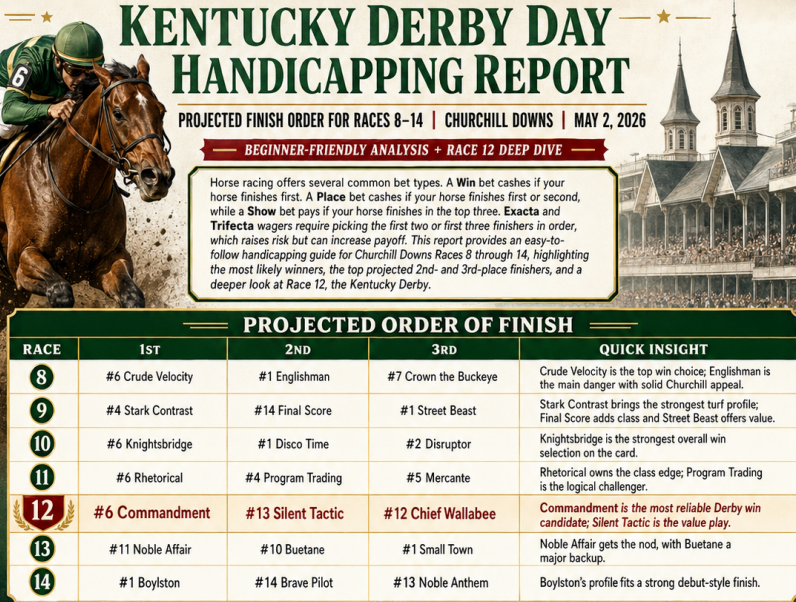
*The vagaries of horse racing, as they often do, had already foiled some of the results by Wednesday, when a scratch took one of the program’s value plays, 20-1 shot Silent Tactic, out of the race.
AI Handicapping Already Here, Already Controversial
The use of artificial intelligence for handicapping has been an increasingly controversial topic in the thoroughbred horse racing industry with the advent of so-called Computer-Assisted Wagering systems.
CAWs not only use AI to predict winners or high-placers, but identify and exploit inefficiencies in pari-mutuel pools, often dumping massive wagers into the system very late in the betting timeframe. One of these consortiums, Elite Turf Club, partners with 1/ST, the owner of Santa Anita Park and Gulfstream Park, for access to their wagering system.
CAWs have outraged railbirds who see the odds on savvy picks exploded by a rush of late bets. These systems, which track their competitors’ bets in real-time, are particularly impactful in smaller races with lower handles because of their ability to swing odds more dramatically.
This was not the goal on American University’s Washington, D.C., campus, where the process began by using a combination of Perplexity, Claude and ChatGPT. Another group of students used the Python coding language to create an interface that allowed for an exchange of data and dialogue that non-coders could understand.
Rail is Dead: Throwing Out the Derby Favorite
Horse racing pre-dated many sports in generating reams of statistics – often in tiny agate type on coffee-stained racing forms – to inform bets, so this project never lacked for data points, including past performances, workout and race times, historical weather conditions, results and, with much greater effort and less success, bloodlines.
The Daily Racing Form was an imperative resource, as was Twin Spires, the gambling platform owned by Churchill Downs Inc. Much of the rest was harvested by “chief quant” and graduate student Camden Egan, using a modified version of a basketball data program.
From there, the coders took the reins, with Mikias Goshime leading a group that helped convert data into consumable, actionable information.
“They essentially created a weighting system where each variable had a specific weight that could easily be adjusted,” Bakowicz detailed. “From our NFL Draft project, for example, we had historical data versus what we saw as tendencies, teams to [draft based on] need. So if you need an edge rusher, you’re more than likely to take an edge rusher.
“So we weighted the historical data at 70% and we weighted the tendencies of what teams need at 30%, and then spit out a model for the Draft. That’s the same thing we do with horse racing.”
Which is why Kentucky Derby favorite and Arkansas Derby-winner Renegade didn’t fare well in the algorithm after drawing the rail. The Derby entrant last to win from that position was Ferdinand in 1986.
“Strictly stats,” Bakowicz, a Commandment backer personally, remarked. “I did not add a human element on that.”
Just two colts have won from the sixth spot (Sir Barton in 1919, Sea Hero in 1993), where Commandment starts. But a race-record 10 have started from the fifth.
Profitable Test at Laurel
The group honed the algorithm by inputting data for non-Derby horses until it began to replicate the actual results.
And then they went to the track to have some fun.
A late-March test run at Laurel Park in Maryland yielded four winners and better insights on refining the weighting system in the model.
A couple of them said, ‘Professor, can we quit our jobs and do this for a living?’,” Bakowicz chuckled. “I said, ‘No, guys.’”
Modeling the First Saturday in May
The students were finally able to run their Kentucky Derby model once the draw was held on Saturday, but the output, Bakowicz admitted, was “a pretty messy coded analysis.” From there, in keeping with the overarching intent of the project, they tweaked to create something that multitudes could understand and use.
“The Kentucky Derby is one of the few events out of the year where everybody participates and nobody knows what’s going on,” Bakowicz said.
Bakowicz and a collection of handicapper friends and counterparts, including lead handicapper and retired AU professor Kevin Boyle, will apply their intuition and experience in a “man versus machine” exercise on Saturday, as they try to outdo the model once final scratches have been announced.
Sometimes, Bakowicz said, the human and the code arrive at the same outcome, as he did with Florida Derby-winner Commandment.
And sometimes not.
“Brad Cox is an excellent trainer. And you have a good legacy of talent with that horse, too,” Bakowicz, justifying his support of Commandment. “That being said, Professor Boyle is sticking with Renegade. He’s handicapped horses longer than I’ve been alive.
“He’s sticking with post position number one.”
Which is why they run the race.
Also read: What Churchill Downs Inc. Gets for Its $85M Preakness Acquisition
The post American University Class Uses AI To Try and Pick Kentucky Derby Winner appeared first on Gambling Insider.