A last-minute influx of submissions highlights growing opposition from tribal groups and policymakers, even as academics and users defend prediction markets as tools for price discovery.
The Commodity Futures Trading Commission’s (CFTC) public comment period on prediction market regulation closes today, with a late surge in submissions underscoring a deepening divide over the future of event-based contracts in the US.
As of 12 pm ET on April 30, more than 60 comments had already been submitted, following a spike of over 80 filings the previous day. In total, there were 1,330 comments at the time of writing.
While the majority have raised concerns about the risks and classification of prediction markets, there is continued support from academics, researchers, and individual users.
The comments are in response to the CFTC’s Advance Notice of Proposed Rulemaking (ANPRM), which seeks public input on the regulation of event contracts under the Commodity Exchange Act.
Institutional Filings Raise Integrity and Consumer Protection Concerns
Among the most prominent late submissions are those from professional and advocacy organizations.
The Institute of Internal Auditors (IIA) warned of “serious concerns about the potential misuse of material nonpublic information,” arguing that prediction market operators require stronger oversight and internal controls.
IIA President and CEO Anthony J. Pugliese recommended that prediction market platforms be required to implement independent audit functions. He emphasized that “rules are not only established but followed.”
Similarly, the National Council on Problem Gambling (NCPG) argued that event contract trading is “functionally gambling.” NCPG stated that prediction markets contain “the three core elements of gambling: consideration, chance, and prize”.
The group called for safeguards, including restrictions on margin trading and protections for minors. It warned that expanded access to such products could increase gambling-related harm.
Academic Submissions Highlight Both Value and Structural Risk
Academic commentary has emerged as one of the most divided voices in the comment process.
On the supportive side, Harry Crane of Rutgers University emphasized the role of prediction markets in aggregating dispersed information and generating probabilistic forecasts that can inform decision-making.
Other academic submissions have taken a more analytical, framework-driven approach.
Michael Li, an incoming Master in Public Policy at the Harvard Kennedy School, wrote that “the public discussion has been organized around binaries that obscure useful distinctions” and called for a more nuanced evaluation of event contracts based on factors such as information structure and manipulation risk.
Similarly, William Mayew of Duke University found that prediction market prices are informative but provide only limited additional value beyond existing disclosures, with improvements that are “economically modest”.
At the same time, more critical academic submissions have focused on market vulnerabilities.
Joshua Mitts, Professor of Law at Columbia Law School, identified widespread indicators of informed trading, including approximately $143 million in “anomalous” profits linked to suspicious activity across prediction markets.
Mitts wrote that prediction markets “derive their principal value from the incentive they create for informationally advantaged participants.” He warned that this same feature makes them vulnerable to exploitation of nonpublic information. According to Mitts, that underscores how price discovery and informational advantage are inherently linked in these markets.
Adding a regulatory perspective, Melinda Roth, a visiting associate professor at Washington and Lee University School of Law and former George Washington University Law School professor, argued in support of the CFTC’s oversight role.
She cautioned that “guard rails should be established against products that settle based on the decisions of an individual or a small group of individuals.”
Tribal and Industry Groups Argue Contracts Are Gambling
Among the most active late submissions were those from tribal governments. They argued that prediction markets fall outside federal derivatives regulation and should be treated as gambling.
The Fort McDowell Yavapai Nation has argued that event contracts amount to interstate wagers. At the same time, the Prairie Band Potawatomi Tribal Gaming Commission urged the CFTC to delay rulemaking and to conduct further consultation with tribal regulators.
Industry groups echoed the argument that prediction markets are a form of gambling. The Casino Association of New Jersey argued that prediction markets are “functionally indistinguishable” from regulated sports betting products. The association also wrote that they create a “two-tiered market” that diverts revenue from licensed operators.
That view has also gained traction in Washington. In her submission to the CFTC, U.S. Senator Catherine Cortez Masto (D-Nev.) argued that prediction markets fall under existing gaming frameworks. She said:
Event contracts dealing with sports and casino games are nothing more than gambling and fall entirely within the jurisdiction of tribes and states.”
Cortez Masto has been a vocal critic of prediction markets and their vulnerability to manipulation. Earlier this year, she was among a group of lawmakers who raised concerns with the CFTC about prediction market contracts that “incentivize” injury or death, and their “dangerous national security risks.”
Supporters Emphasize Innovation and Market Utility
Despite the growing institutional pushback, a significant portion of the comment record continues to defend prediction markets as valuable financial tools.
Supporters argue that event contracts:
- Improve price discovery
- Provide forward-looking signals on economic and geopolitical events
- Offer risk management and hedging opportunities
Some submissions also caution that restrictions could push users to offshore platforms, reducing transparency and weakening consumer protections.
Others advocate for regulation rather than prohibition, suggesting that prediction markets can coexist with existing frameworks if appropriately designed.
These proposals include:
- Enhanced surveillance systems to detect insider trading
- Clearer standards for contract design and resolution
- Differentiation between high-risk and lower-risk event categories
Kalshi’s AI-Generated Comments Play a Limited Role
Recently, reports showed that Kalshi created a page to generate AI-powered supportive comments to submit to the CFTC.
The page allows users to select different scenarios in a questionnaire-based filing based on their activity, interests, and reasons for supporting prediction markets. At the end, the page allows users to directly submit their AI-generated comments to the CFTC or provide a link for manual submissions.
Gambling Insider tested the tool across multiple scenarios. See the images below.
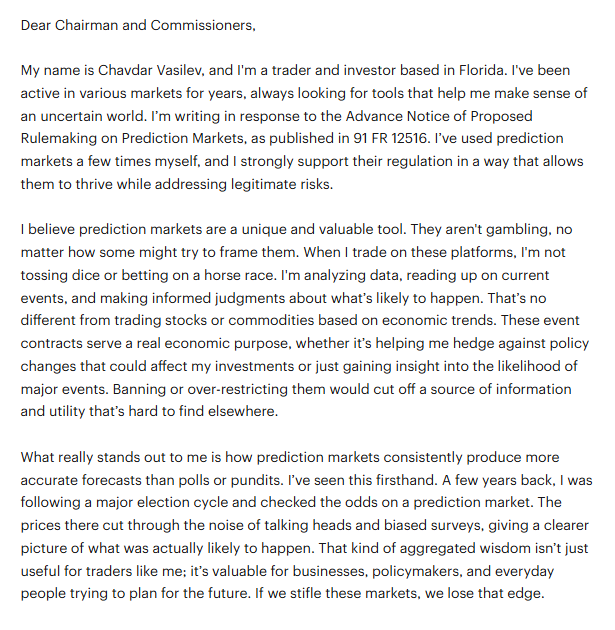
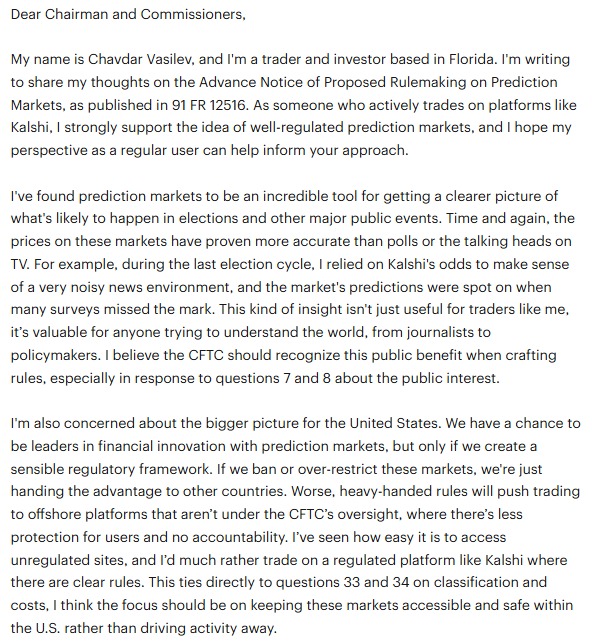
Despite some reports suggesting that AI-generated comments have significantly contributed to the over 1,300 total comments, Gambling Insider found that, in the last approximately 120 comments, only about 15 were submitted through Kalshi’s page. That suggests they have not materially shaped the overall direction of the comment record.
The post CFTC Comment Deadline Triggers Final-Day Surge as Divide Over Prediction Markets Sharpens appeared first on Gambling Insider.