
Transportation rates rose again in June as capacity across the sector tightened further, according to data from a monthly survey of supply chain professionals.
The Logistics Managers’ Index—a diffusion index in which a reading above 50 indicates expansion, while one below 50 signals contraction—returned a 92.4 reading for transportation prices in June. That was only 3.6 percentage points off the record pace set in May.
Transportation capacity (30.8) declined 90 basis points during the month, while transportation utilization (74.7) increased 5.2 points. Transportation capacity has declined in seven consecutive months.
Utilization accelerated throughout the month, increasing from 69.2 in the first half to 78.8 in the back half—an eight-year high. Public truckload carriers have focused on improving utilization through better load planning and freight selection in recent quarters.
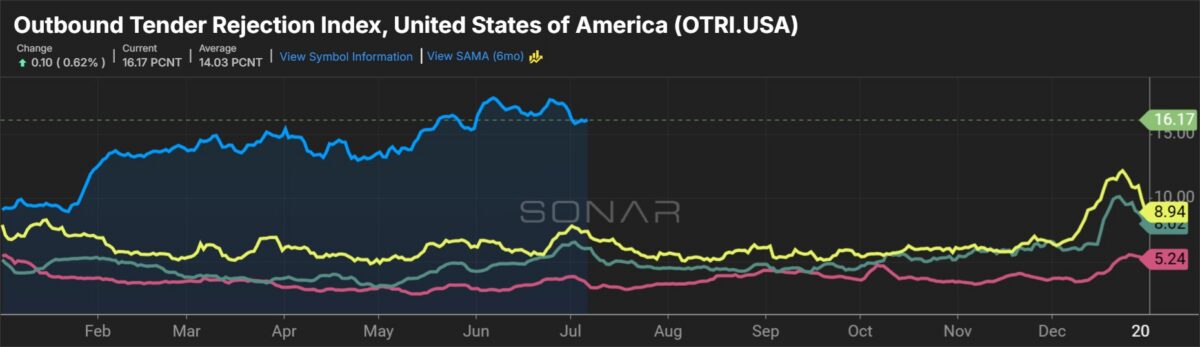
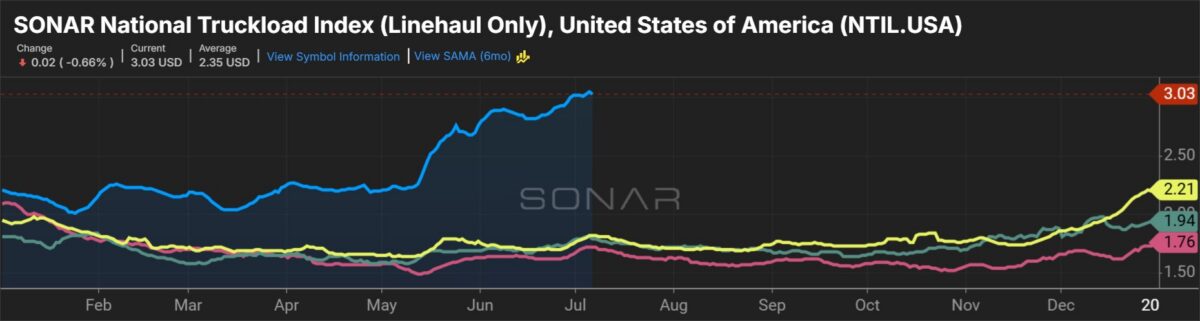
Truckload fleets appearing at an investor conference last month said stricter regulatory enforcement has resulted in a material drawdown in supply. The group noted that routing guides are crumbling. Contractual rates set earlier in the year aren’t holding and many shippers are being forced to reprice some or all of their books.
Logistics managers surveyed expect the transportation market to remain very tight over the next 12 months, returning future readings of 42.4 for capacity, 75.8 for utilization and 87 for pricing.
Retailers already building inventories ahead of peak season
The overall LMI registered a 71.1 reading in June, up 1.6 points from May, and the first time the dataset has crossed 70 (significant expansion) since March 2022.
Inventory levels (60.5) were up 5.7 points, driving the bulk of the increase in the LMI. Large companies (over 1,000 employees) and downstream retailers reported faster inventory growth rates. Restocking activity intensified as the month progressed, increasing from 55.4 in the first half to 66.3 in the back half.
“Retailers appear to be encouraged by the continued strength in consumer spending, rushing in goods for the back-to-school season,” the Tuesday report said. “This is a noted shift from the wait-and-see approach that retailers had been employing through most of the spring.”
Inventory costs (75.9) accelerated but at a pace that was 8.1 points slower than May. Responses showed inventory costs grew 12 points faster downstream than upstream (manufacturers and wholesalers).
The report said retailers were taking delivery of goods early this year to avoid potential tariffs. Ocean shipping companies also implemented new surcharges at the beginning of July.
Higher inventory levels led to some tightening in the warehousing metrics.
Warehousing capacity (47.5) declined 3 points, with warehouse utilization (69.4) increasing 6.5 points. Warehouse prices (73.8) were up 3 points, with large companies seeing significant growth (81.9) as they took delivery of inventory.
Aggregate logistics costs (inventory, warehousing and transportation) were down 8.7 points to 242.1 in June. May marked the fastest rate of expansion for the all-in cost dataset since March 2022.
The LMI is a collaboration among Arizona State University, Colorado State University, Florida Atlantic University, Rutgers University and the University of Nevada, Reno, conducted in conjunction with the Council of Supply Chain Management Professionals.
More FreightWaves articles by Todd Maiden:
- June manufacturing data supportive of LTL demand
- Prologis presses Segro after $16.6B offer rejected
- Yellow Corp. escapes WARN Act payouts
The post Transportation pricing index hovers near all-time high in June appeared first on FreightWaves.
