NICOSIA — Spanish Prime Minister Pedro Sánchez on Friday downplayed a leaked Pentagon email suggesting Spain could be penalized for not supporting the war in Iran by having its NATO membership suspended.
“No worries,” Sánchez told POLITICO at his arrival at a summit of EU leaders in Cyprus. “We are fulfilling our obligations toward NATO.”
“The Spanish government’s position is clear: absolute cooperation with our allies, but always within the framework of international law,” Sánchez added, while addressing a larger group of journalists.
The prime minister declined to discuss the specific content of the leaked Pentagon document, which was first reported by Reuters, insisting his government “does not comment on emails, but rather on official documents and positions taken, in this case, by the United States.”
The email, which was described to Reuters by a U.S. official, consists of a series of policy measures U.S. President Donald Trump’s administration could adopt to punish NATO allies whom Washington considers “difficult” or insufficiently supportive of the war in Iran.
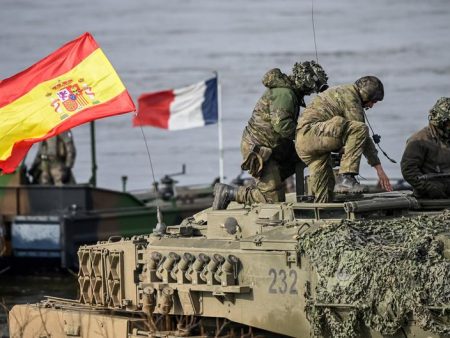
Spain — one of the conflict’s most vocal opponents and a NATO defense spending laggard — is singled out for outright suspension from the defense alliance, reflecting Trump’s ire at Madrid. The president was infuriated by Sánchez’s decision to ban U.S. warplanes from using jointly operated military bases or Spanish airspace to attack Iran, and last month threatened to cut off all trade relations with the country.
NATO’s founding treaty does not include any mechanism that would allow for the suspension or removal of one of its members. The document only contemplates voluntary withdrawals from the alliance, which require a one-year notice period.
Meanwhile, restricting countries from winning top military command posts would be hard to achieve since NATO allies have just renegotiated new changeovers that are due to last until 2029, she said, and reopening negotiations would require unanimity.
“It’s hard to know how seriously we should take such emails beyond ideological trolling,” said Oana Lungescu, a former NATO spokesperson and senior fellow at the Royal United Services Institute.
The leaked Pentagon email also suggests Washington could review its position on Britain’s claim to the Falkland Islands in retaliation for the U.K.’s refusal to participate in the war in Iran.
Trump was incensed by U.K. Prime Minister Keir Starmer’s decision to stay out of the conflict, and last week suggested he might punish London by shredding a key trade agreement. But altering Washington’s stance on the Falklands would mark a major escalation in the eroding “special relationship.”
The U.K. and Argentina have spent centuries locked in a sovereignty dispute over the South Atlantic islands, which are a British Overseas Territory. Buenos Aires launched an invasion of the Falklands in 1982, triggering a 74-day war that was handily won by Britain, with material and logistical support provided by the U.S.
Argentine President Javier Milei — a Trump ally — has expressed tolerance for British rule over the islands, but at a memorial service for the war’s fallen in Buenos Aires earlier this month he reaffirmed his country’s claim on the Falklands.
Another option considered in the email is the U.S.’s own withdrawal from NATO. Trump first threatened to pull out of the alliance during his first term in the White House, and has repeatedly floated the idea since his reelection. After allies declined to join the attack on Iran, the president and his team vowed to reassess its membership.
It’s unclear if the Pentagon email is related to the “naughty and nice” list of NATO countries the White House prepared ahead of NATO Secretary-General Mark Rutte’s visit to Washington in early April. European diplomats and a U.S. defense official familiar with the document told POLITICO that it included an overview of members’ contributions to the alliance and placed them into tiers.
U.S. Defense Secretary Pete Hegseth in December suggested “model” U.S. allies should receive special favor, while those who “fail to do their part for collective defense” should face “consequences.”