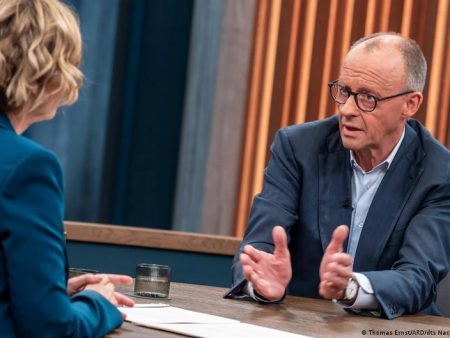
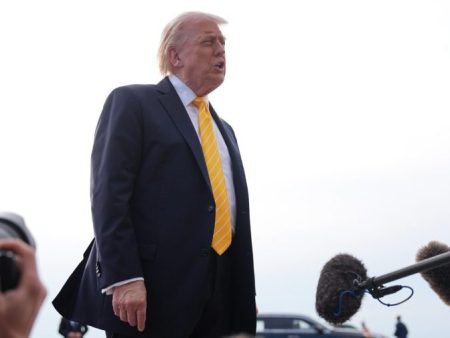
BERLIN — German Chancellor Friedrich Merz tried to lower the temperature of transatlantic relations on Sunday by talking up his relationship with President Donald Trump — but didn’t pretend things are rosy.
After Merz took a swipe at Trump over U.S. military action in Iran last week, the president responded by insulting Merz on social media and saying he would pull American troops out of Germany. Days later he threatened to hit the EU with higher auto tariffs.
“I believe that a good partnership includes respecting differing views,” Merz said during an interview on German public channel ARD. “I do that, and I think he does as well — at the moment perhaps a bit less.”
“I was with him eight weeks ago,” Merz said of Trump. “We have conversations at somewhat longer intervals but fairly regularly … but not in the past week.”
The decline of the pair’s previously good relationship has done Merz no favors. Trump’s talk of troop cuts has amplified uncertainty over long-awaited missile deployments, and the president’s renewed tariff threats are unwelcome given the German economy is already expected to suffer from the fallout of the U.S. and Israel’s war with Iran.
The episode reflects a broader pattern in the chancellor’s communication style, which has drawn criticism at home for being overly blunt on sensitive issues. Merz has acknowledged the risk, but insists he won’t fundamentally change how he speaks.
“When I see such reactions, I ask myself what I could have said better,” he noted in the interview. “I’ll say it better next time. But I won’t say something different.”
Merz has framed the approach as deliberate, arguing voters expect candor from their leaders even if it occasionally creates friction.
“I don’t want to speak like a polished pebble,” he said. “That’s not my style.”
He added: “I will not give up on the transatlantic relationship, and I will not give up on cooperation with Donald Trump.”
Merz on Sunday sought to play down the substance of the dispute, particularly the threat of a U.S. troop withdrawal, framing it as part of longer-running military planning rather than a sudden rupture.
“There is a contingent of American soldiers in Europe that [former U.S. President] Joe Biden stationed here on a temporary basis. Their withdrawal has been discussed for quite some time,” he said, noting that Washington frequently shifts its forces globally.
On military support, however, the picture is more uncertain. A 2024 U.S. commitment to supply long-range Tomahawk missiles to Germany — which have yet to be delivered — has not been renewed under Trump, raising concern in Europe about ongoing deterrence gaps against Russia.

“We had received a commitment from Joe Biden to deliver Tomahawk missiles. Donald Trump has not repeated that. He has not given us that commitment so far,” Merz said.
However, the chancellor suggested the issue may be less political than practical: “As I see it at the moment, there is objectively hardly any possibility from the U.S. side to provide such weapons systems.”
Another source of friction is trade. Trump has threatened fresh tariffs on EU exports, including cars — which would hit Germany’s economy particularly hard. But Merz struck a measured tone, even acknowledging some U.S. frustration with stalled trade negotiations with the EU after Trump struck a deal last July with European Commission President Ursula von der Leyen at his Turnberry golf resort in Scotland.
“To be frank, he is somewhat rightly disappointed that we in the European Union have still not reached a conclusion,” Merz said. “We have not signed it. The Americans have it ready, and the Europeans do not.”
He urged Brussels to move quickly to implement the deal: “That’s why I hope we can reach an agreement as quickly as possible,” he said, while reiterating that “we do not share the fundamental view that tariffs are a good thing.”
A lighter moment came when the conversation turned to football and the men’s World Cup, which is set to be jointly hosted by Canada, Mexico and the U.S. this summer.
Asked whether a German victory over the Americans might trigger fresh tariff threats, Merz demurred. “I’m still convinced the Americans would take that in a good spirit,” he said — before adding confidently: “And in soccer, I think we’re better.”