If you have been running the load board for the past three years, you know what the bottom felt like. Loads sitting for hours. Brokers lowballing you on every call. Rates that barely covered fuel, let alone the truck payment. That was the freight recession — and it held from 2022 through most of 2025.
Something has shifted. You are feeling it. The board is busier. Brokers are calling instead of waiting for you to call them. Rates are up — meaningfully up. And there is a voice in the back of your head saying: now is the time to add another truck.
Why Rates Are Up Right Now
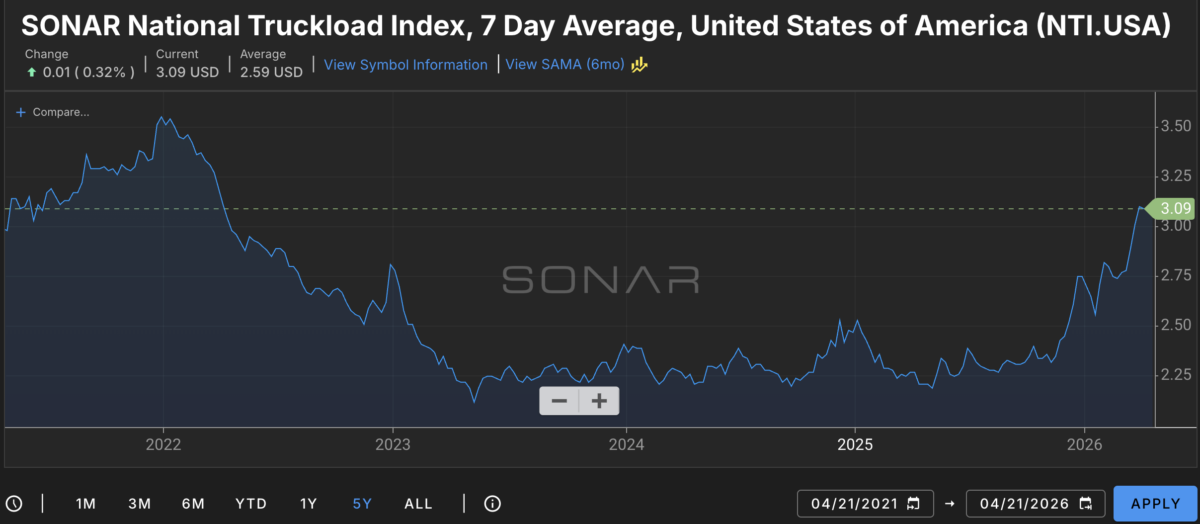
The spot rate per mile on a national basis is sitting at $3.09 as of this week. The six-month average has been $2.59. That $0.50 difference tells you how fast rates have moved. To put it in context: during the worst of the freight recession, rates were running around $2.10. You have come up nearly a dollar per mile from the floor.
Here is the thing: rates are not up because shippers are suddenly moving a lot more freight. They are up because there are significantly fewer trucks available to move the freight that exists.
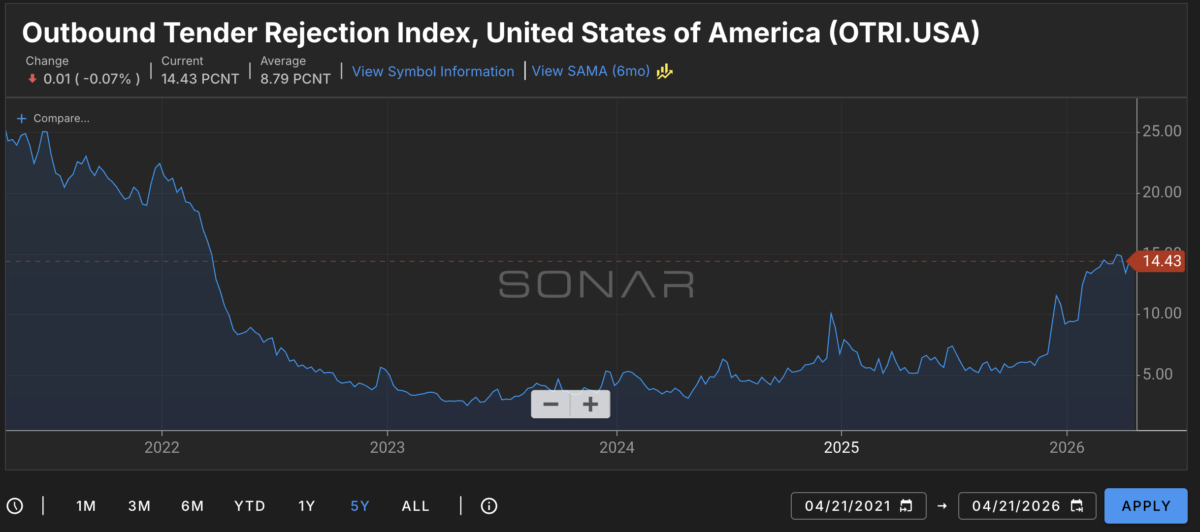
Carriers have been leaving the market for three years. Some filed bankruptcy. Some parked their trucks and gave back their authority when the math stopped working. Others lost operating authority through regulatory enforcement. The result is a market where the trucks that are left have more leverage than they have had since 2021 — not because the economy is booming, but because there are fewer competitors for every load.
That is a real and meaningful improvement. But it is a different kind of improvement than 2021. In 2021, freight was everywhere and rates went up because shippers needed trucks desperately. Today, freight is not everywhere — and that difference matters for what you do next.
The Number That Should Give You Pause
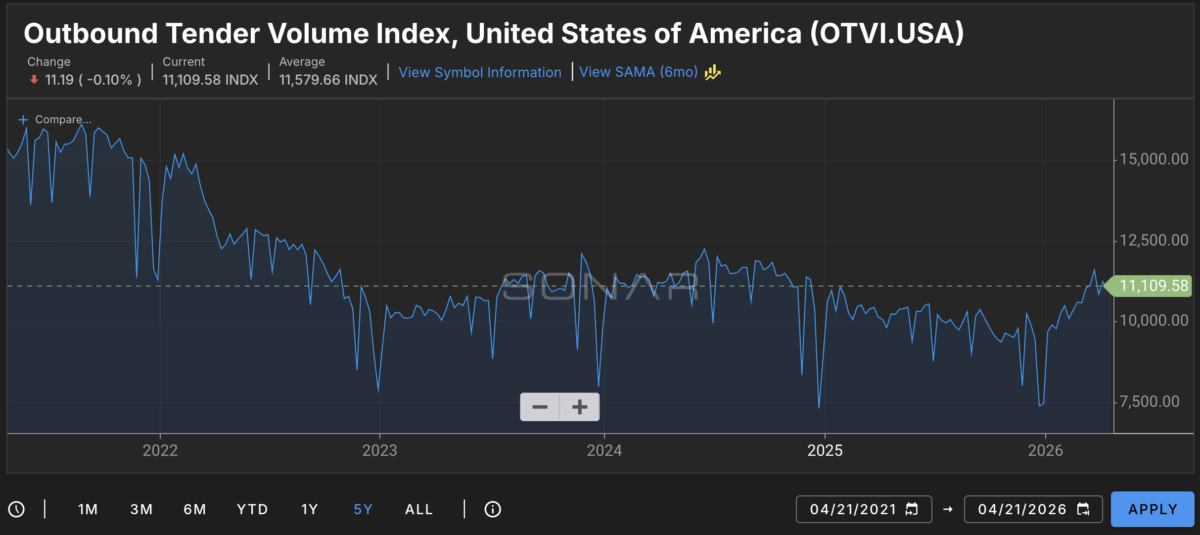
Right now, the data that measures how much freight is actually being tendered — load requests sent from shippers to carriers before freight moves — is declining. Week-over-week, it is down 1.1%. Over the past month, it is down 1.78%.
In plain English: there are fewer loads entering the market than there were a month ago. At the same time, there are fewer trucks. Rates are up because trucks are scarce, not because freight is abundant.
Why is freight volume declining right now? The short answer is tariff uncertainty. Shippers who are not sure what imports are going to cost, or what their customers are going to buy, are slowing down how much they ship. They are sitting on inventory and waiting. That behavior pulls freight out of the market even when the underlying economy is not collapsing.
JB Hunt’s CEO said on their earnings call this week that the freight environment “felt meaningfully different” than recent years — and their numbers backed it up. But their CFO was careful to describe the recovery as “predominantly supply-driven” with only “early signs” of demand improvement. That is the same story the data is telling: supply tight, demand uncertain.
What This Means If You Run the Load Board
If you are a load board operator — one truck or a handful of trucks, finding your freight on DAT or Truckstop — here is what the current market means for you in practical terms.
Right now is the best time in three years to hold your rate. When brokers are scrambling to cover loads because contract carriers are turning them down, they need you. You have leverage you did not have in 2023 or 2024. Use it. If a broker offers you a rate that does not work, say no and mean it. The next broker will call.
Right now may not necessarily be the best time to add a truck (every case is different), because adding a truck means finding two trucks worth of loads instead of one — and the supply of available loads is declining month over month even as rates are elevated. A tight market with fewer loads is great for the truck you already have running selectively. It is riskier for a truck that needs to run consistently to make its payment.
Here is the scenario you want to avoid: you buy a truck in April because rates are at $3.09. In June, tariff uncertainty creates a demand slowdown — fewer loads in the market. Rates dip back toward $2.75 or $2.80 because the volume of available loads has shrunk. Now you have two trucks competing for the same load board in a softer environment, with a truck payment that does not care what happened to rates.
That scenario is not guaranteed to happen. But the declining load volume data says it is possible, and you need to have a plan for it before you commit to new equipment.
The Sign to Watch For
There is a signal that will tell you when expanding makes sense — and you do not need a data subscription to see it.
Watch the load board in your primary operating markets for three things: how many loads are posted on your lanes, how long they sit before disappearing, and how quickly brokers respond when you decline a rate. When all three of those move in a positive direction simultaneously and hold that way for four to six consecutive weeks — loads increasing, moving faster, and brokers countering instead of walking — that is demand coming back to match the tight supply. That is the setup where adding a truck is backed by the data, not just the feeling.
Right now, supply is tight. That part is confirmed. Demand is still uncertain. When demand confirms, you will feel it on the board before any report tells you about it. That is your signal to move.
The Four Questions Before You Sign Anything
If you are seriously considering adding a truck, answer these four questions honestly before you do anything else.
Where is the freight coming from for that truck? Not in general — specifically. If your answer is “the load board will have something,” that is not an answer. The load board has something today. It may have less of something in sixty days if freight volume keeps declining. Before you add equipment, know which shipper, which lane, or which broker relationship is going to keep that truck moving. If you cannot name it, the truck is not ready to be added.
Can you cover that truck’s fixed costs for 90 days without touching your operational cash? A truck payment, insurance, and fixed overhead run whether the truck is moving or not. If the market softens for six weeks while you are trying to get the new truck producing, those bills still hit. If you do not have that cushion in cash, you are betting everything on the load board staying exactly where it is. That is not a business decision. That is a gamble.
Is your current truck generating real margin right now — not just covering costs? If you are at $3.09 per mile and still running thin because fuel, insurance, and maintenance have all gone up, expanding does not fix that. It compounds it. Make sure the truck you have is genuinely profitable before you add the overhead of a second one.
What happens to your operation if rates go back to $2.60 next quarter? That is the six-month average. It is not an extreme scenario. It is where rates have spent most of the past six months. If your expansion plan does not survive a return to $2.60, the plan is built on today’s spike, not the real market.
What the Right Move Looks Like Today
The current freight market is the best environment for a load board operator since before the recession. Rates at $3.09, a market where saying no to a bad load actually works — that is real, and it is yours to use right now.
The right move is to extract every dollar of that advantage from your current operation. Hold your rate. Run fewer miles at better pay. Decline the loads that do not cover your full cost. The tight supply market gives you permission to be selective in a way you have not had for three years. Take it.
Build your cash reserves with what the current market is generating. Watch whether the number of available loads on your primary lanes starts growing or keeps shrinking over the next four to six weeks. If loads come back and rates hold, you will know it — and you will have the cash cushion to act on it confidently.
The expansion conversation is not off the table. It is on the right side of a confirmation that the data has not yet fully provided. When it does, you will have the reserves to move fast. That is the position you want to be in — ready to expand from strength, not forced to because you already signed the paperwork.
The post Every Recovery Looks Like the Right Time to Add a Truck. Here Is How to Tell If It Actually Is. appeared first on FreightWaves.