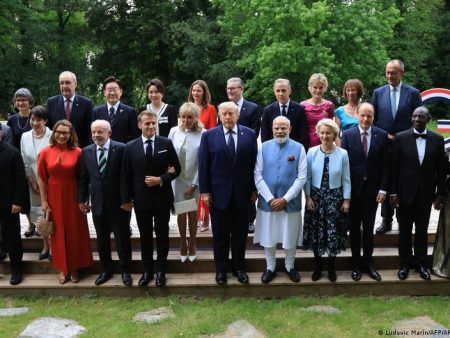
EVIAN-LES-BAINS, France — G7 countries on Tuesday expressed willingness to help President Donald Trump with next steps in Iran, including a complicated effort to remove mines from the Strait of Hormuz — that is, if the deal to end the war is as solid as Americans project.
Amid questions about the yet unreleased Iran memorandum of understanding due to be signed Friday, French President Emmanuel Macron said this week he could be ready to quickly deploy fighter jets and frigates, but that a request must come from not only the U.S., but also Iran and Oman. A U.K. official said Britain “stands ready” to send assets to the region but would not specify conditions or a timeline for deployment.
German Chancellor Friedrich Merz appeared keen on providing help, too, but said only once the “necessary conditions” are in place. And Italian Prime Minister Giorgia Meloni, during Tuesday’s lunch with Middle East Leaders, said Italy was willing to keep contributing to missions that guarantee security for trade, according to an Italian diplomat granted anonymity to speak about private discussions. But she also insisted that long-lasting solutions were needed especially in Gaza and in Lebanon, which could be a major stumbling block to Trump’s agreement with Iran.
U.S. officials this week at the G7 have prioritized getting international cooperation to quickly demine the strait, through which roughly one-fifth of the world’s oil flowed before the war began.
Trump, during Monday’s dinner with the other leaders, “insisted a lot on the reopening of Hormuz and on the need to clear the strait of mines,” according to a G7 official granted anonymity to disclose the private conversation.
“I don’t think it’s a bad idea to have a ship or two up here from a few countries. You’d be a great country to do it,” Trump said during his bilateral meeting with Macron on Monday.
But Europe’s cautious response speaks to the lingering uncertainty surrounding the Trump administration’s promise to end its war with Iran. The White House has not released the full details of the memorandum of understanding, complicating discussions among leaders at the Évian summit.
“The Europeans have a lot of experience in negotiating with Iran. They know how difficult it can be. They know how savvy the Iranians are about playing every opportunity. And I imagine they just don’t want to be left holding the bag,” said Suzanne Maloney, a Middle East analyst who directs the Brookings Institution’s foreign policy program.
“If [Europeans] can find a way to take greater ownership without necessarily being responsible for an outcome that they can’t control, then I think there’s an opportunity here.”
The war in the Middle East has shaken global energy markets, disrupting supplies and adding to inflation pressures felt far beyond the region. While the U.S. has endured some economic pain, the impact has been particularly acute in countries far more dependent on the strait. European allies are eager to see the passage fully reopened and for shipping volumes to return to prewar levels, but experts acknowledge that restoring normal operations could take weeks as Trump administration officials and partners sort through the path forward.
One senior Trump administration official granted anonymity to speak freely, told reporters this week that participation from G7 countries could be a “very helpful thing to get things back to normal as quickly as possible.”
Some European allies have already shown interest. France and Britain have pushed plans for a multinational mission to safeguard shipping and to help clear mines. And British military divers have been preparing to conduct mine-clearing operations, POLITICO reported last month.
“We have already sent the first mine-clearing vessels or ships to the region,” Merz said Wednesday. “We are prepared.”
Allies are eager to assist the U.S. for a number of reasons — including the economic benefits of a fast reopening. But it’s also a way for leaders to repair frosty relations after Trump has complained that European leaders didn’t do enough to assist the U.S. in its military operation, rejecting requests to help enforce blockades and secure the Strait of Hormuz.
“I think the allies will be interested in helping as long as it is in cooperation with Iran…it lets them show a contribution to President Trump,” said a former Trump official, granted anonymity to speak candidly.
“And it is an implied tweak of us, because it suggests they’re helping clean up the aftermath like a responsible party. It also is a bargaining chip or talking point to help them get back in the room in the follow-on final deal negotiations and also maybe the Ukraine negotiations,” the former official continued.
Trump did suggest this week that the Iran deal gives him more bandwidth to focus on the war in Ukraine, as the country is desperate for more U.S. missiles as it, for the first time in years, makes gains on Russia. The president also suggested Wednesday that the U.S. let lapse the waiver on Russian oil sanctions, which will expire Wednesday — as G7 allies look to ramp up the pressure on the Kremlin.
“Soon, we’ll be able to do that because the oil is now flowing,” Trump said. “We took sanctions off because obviously we’re not looking to impede the oil, but we’re in a position to do that soon.”
Gordon Repinski contributed to this report.