In Baltimore, CSX executives and a host of dignitaries inaugurated a $495-million rail tunnel project that’s expected to boost intermodal container traffic at the city’s port, and along the I-95 East Coast corridor.
Maryland Governor Wes Moore was joined by state and local elected officials, rail and labor leaders at a ribbon-cutting ceremony at the newly reconstructed Howard Street Tunnel. It marked the official opening of double-stack rail service at the Helen Delich Bentley Port of Baltimore.
“This is a transformative day for the Port of Baltimore and for Maryland,” said Moore. “Thanks to our public-private partnership, we have opened doors to shipping up and down the Northeast, increasing our shipping capacity at the port, creating thousands of new jobs and generating about $1 billion annually in economic benefits for Marylanders, all while reducing emissions and benefitting the environment.”
CSX ran a ceremonial train through the 131-year-old tunnel, opened by the Baltimore & Ohio Railroad in 1895, this past September. Regular service commenced several weeks ago.
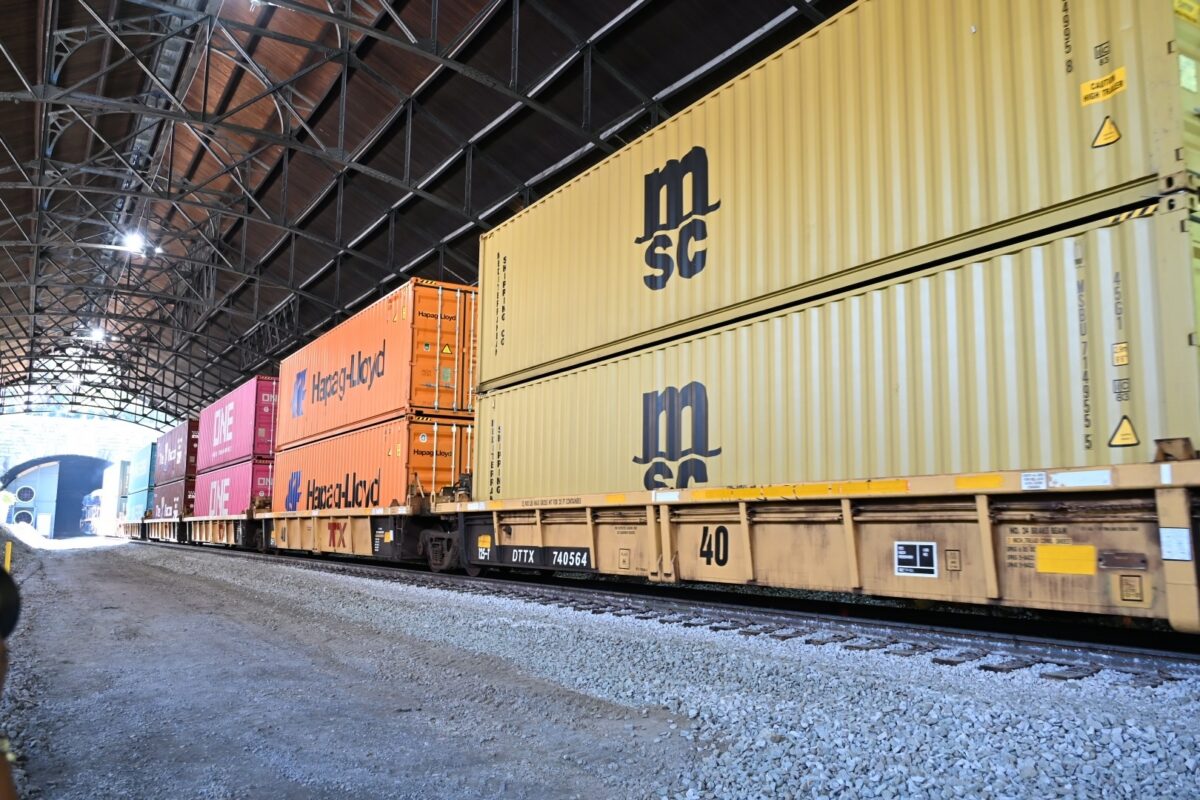
The project expanded clearance by 18 inches and made similar improvements at 21 locations in Maryland, Delaware and Pennsylvania to allow for double-stack container trains passage to and from the Port of Baltimore. It’s expected to provide seamless double stack capacity from Massachusetts to Florida, and into Midwest markets.
Prior to the tunnel improvements, trains commonly detoured north and west out of Philadelphia to Selkirk, N.Y., using the CSX/B&O and River Line route instead of the Baltimore corridor. Another was to divert toward Hagerstown, Md., and hand traffic to Norfolk Southern for movement via its Lurgan and Harrisburg lines back toward Philadelphia, then rejoin CSX tracks.
Maryland officials cited the public-private partnership between the state, Federal Railroad Administration, and CSX (NASDAQ: CSX) for helping to complete the project for less than the estimated $566 million cost. That included investment of $217 million from the state, and $125 million in federal funding.
Moore was joined by CSX Chief Executive Steve Angel, Federal Railroad Administrator David Fink, and Sens. Chris Van Hollen and Angela Alsobrooks at the ceremony.
“With full double-stack clearance now in place, we’ve removed a long-standing constraint in Baltimore and unlocked a more direct, efficient connection between the port and inland markets,” said Angel. “This strengthens a critical link in our network and enables us to move more freight on existing trains, giving customers greater access, capacity and flexibility across the East Coast.”
The port over time expects to increase container volume by about 160,000 containers annually. An estimated 13,000 new jobs are expected to be created from the expanding business, including construction jobs on the project itself as well as future operations, warehousing and logistics jobs.
Baltimore’s Seagirt Marine Terminal terminal operated by Ports America handled a record 1,113,309 twenty foot equivalent units in 2025. Weekly container ship calls rose from 12 in 2024 to 15; Mediterranean Shipping Co. will open a new Asia and Mediterranean container service July 1.
“This is one of the most significant accomplishments in the history of the Port of Baltimore,” said Maryland Port Administration Executive Director Jonathan Daniels. “Expanding a 131-year-old freight tunnel by lowering the track 18 inches to provide the necessary clearance to handle double-stacked containers will generate more business and jobs for the port while also creating valuable environmental benefits. Now with double-stack capabilities, the Port of Baltimore becomes the quickest and most efficient way to get containerized cargo to the Midwest.”
Ports America has invested more than $600 million in infrastructure, equipment and technology improvements in Baltimore since 2010.
“This is a game-changing initiative for Ports America Chesapeake and the container business at the Port of Baltimore,” said Ports America Chesapeake President Mark Schmidt. “We are deeply invested in continuing to make Seagirt one of the top performing container ports in the nation and the ability to double stack containers will assist in that effort.”
The project is expected to reduce truck fuel consumption by about 137 million gallons and truck vehicle miles by 1.2 billion over 30 years.
Baltimore handled 50 million tons of total foreign cargo in 2025, its second-best year ever. It’s the second-busiest U.S. gateway for autos, imported gypsum, salt and sugar, and export coal.
Subscribe to FreightWaves’ Rail e-newsletter and get the latest insights on rail freight right in your inbox.
Read more articles by Stuart Chirls here.
Related coverage:
BNSF wins local approval for new $4B California rail intermodal project
Intermodal pulls away from carload rail freight
Rate, service issues flagged by ag retailers in Union Pacific-Norfolk Southern rail merger
FreightWaves Today: Broad rail traffic gains show growing industrial economy
The post CSX officially opens $495 Baltimore intermodal rail tunnel project appeared first on FreightWaves.