ROME — Italian Prime Minister Giorgia Meloni will try on Thursday to revamp her premiership, after rising energy prices and her ties to U.S. President Donald Trump helped contribute to a bruising referendum defeat last month.
“The war created uncertainty, and a sense of fear has prevailed among those alarmed by the rise in petrol prices,” said Paolo Barelli, whip for the center-right Forza Italia party and member of the coalition government, after the electoral loss.
During an address to parliament, Meloni will attempt a political relaunch, recasting her agenda around energy security and distancing herself from Trump.
Her high-profile visit to the Gulf last weekend was a first signal that energy security is now central to her political strategy, framed explicitly as a matter of national interest.
Her speech, which will touch on issues popular with her base such as security and migration, is also expected to build on already-implemented measures like cuts to fuel excise duties to cushion households and businesses from rising energy costs. The announcement comes in response to a Bank of Italy report published on Friday that revised down growth forecasts due to “exceptionally high uncertainty.”
The push on energy will also concern Italy’s relationship with Brussels.
Meloni’s government is arguing for the EU to make its fiscal rules more flexible, presenting the crisis as grounds for loosening spending constraints tied to energy security.
On Wednesday, Deputy Prime Minister Matteo Salvini said it was the government’s “priority” and likened EU debt rules to a “straitjacket.” European officials have also begun to signal openness: France’s European Commissioner Stéphane Séjourné said that the bloc would not rule out greater flexibility in light of the crisis.
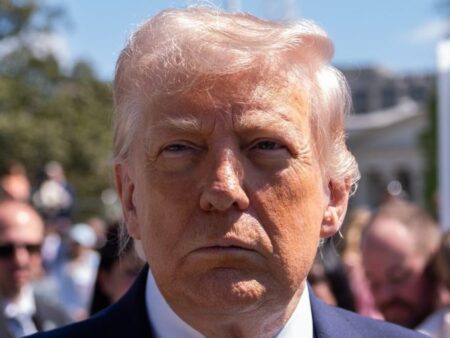
Meloni’s repositioning also extends to foreign policy, where her tone regarding Trump has hardened in the wake of the referendum. In an interview with state broadcaster RAI last week, the prime minister insisted that while there is “little to gain” from difficult transatlantic ties, her priority is to “defend national interests”. She added: “When we don’t agree, we say so — and this time we do not agree.”
Her office reinforced that message on Tuesday, stressing alignment with European partners on the need to “preserve civilian infrastructure,” following Trump’s repeated threats to target Iranian power plants and bridges. At the end of March, Italy refused to allow a U.S. bomber mission to land at a base in Sicily en route to the Middle East, though Meloni stressed that the episode did not represent a conflict with Washington.
A bit of conflict with Washington might not go amiss, though. Meloni’s allies see her previously rosy relationship with Trump as a liability, blaming it for the referendum loss.
“Until [the Iran war happened] we were ahead, then there was a dramatic fall,” a coalition lawmaker told POLITICO, pinning referendum defeat on the war in the Middle East. “For better or worse, in the collective imagination, the right was associated with Donald Trump,” he added.
Nicola Lupo, a professor of public law at LUISS University, said the referendum and polling suggest that alignment with Trump carries political costs, adding that across Europe it has become “toxic — even on the right — to be seen as close to Trump.”
The government ruled out early elections amid global instability and energy shocks. But Meloni’s political future still depends on how the international crisis develops — and her perceived proximity to its architects — as much as it does on ability to keep her coalition united and proposed changes to electoral law that would deliver the winning party a bigger parliamentary majority.