Italian Defense Minister Guido Crosetto sounded the alarm on Tuesday over the risk that the Iran conflict could turn nuclear.
“Madness seems to have gripped the world,” Crosetto told the country’s parliament on Tuesday, echoing remarks from an earlier interview with Corriere della Sera in which he warned that “what is already tragic could become even worse.”
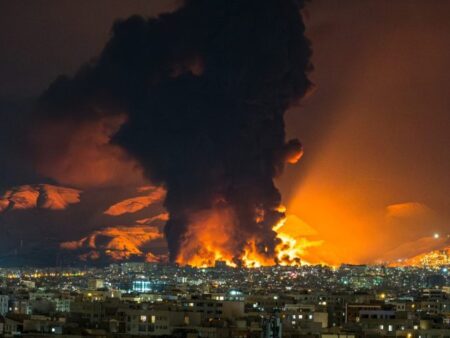
His comments come amid U.S. President Donald Trump’s increasingly dire threats against Iran, which the United States and Israel have been attacking since the end of February.
“Consider that it is human beings like us who decided that even Hiroshima and Nagasaki were acceptable to end a conflict,” Crosetto told Corriere, adding that “we continue to have nuclear weapons, and those who don’t have them are looking for them. We have learned nothing.”
Pressed on whether he believed there is a real nuclear threat, he said: “I don’t even want to say the word. The risk is madness, and what we’re experiencing is a conflict where every action requires a higher-level reaction.”
While the U.S. and Israel’s military campaign has killed numerous Iranian leaders and severely depleted the country’s missile production capabilities, the regime in Tehran remains in power. Iran’s retaliatory closure of the Strait of Hormuz is wreaking worldwide economic havoc, ramping up the pressure on Trump to end the war.
Writing on social media on Tuesday, after the interview with Crosetto was published, Trump said in reference to Iran: “A whole civilization will die tonight, never to be brought back again.”
A World Health Organization official said in March that the organization is preparing for a nuclear catastrophe should the war continue to escalate.
One of the war’s stated aims was to prevent Iran from obtaining nuclear weapons capabilities. This objective has been achieved, according to multiple U.S. and Israeli sources.
The United States and Israel both have nuclear weapons, though Israel’s leaders refuse to confirm or deny their existence.
The U.S. is the only country to have used nuclear weapons, bombing the Japanese cities of Hiroshima and Nagasaki in 1945 during the Second World War. More than 100,000 people died as a result of those bombings, according to even the most conservative estimates.