Over the past several years, investigators working through The Bannon Report have tracked freight fraud, cargo theft, identity misuse, and suspicious activity across the industry. While records go back earlier, the first clean dataset began in 2022. That snapshot included about 1,400 entities tied to investigations or known risk. At that time, the list supported active cases, not long-term analysis.
As investigations continued, the dataset grew fast. By September 2024, it reached 17,000 entities. That growth did not come only from new cases. It came from a clearer view of how fraud operates. Fraud does not move through one company. It moves through groups of related entities that share contact details, documents, or behavior. As those links became clear, more companies came into scope.
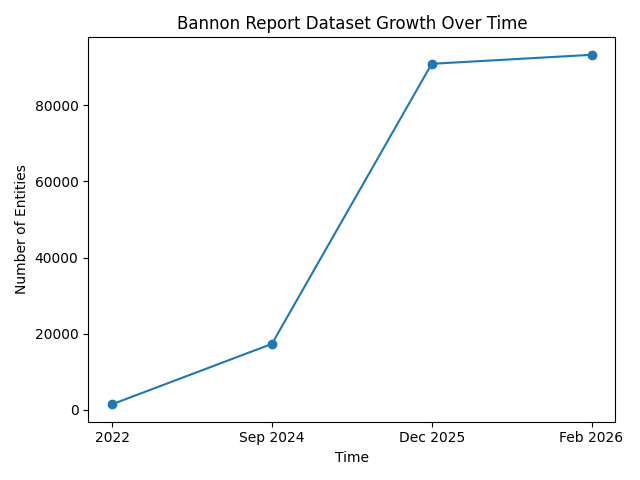
The largest jump came in 2025. The dataset grew from about 17,000 entities to more than 90,000. By December 2025, the total reached 91,000. It continued into early 2026, reaching 93,000 by February. At first glance, this looks like a surge in fraud. In reality, it shows something different. Investigators are not finding thousands of new fraud companies. They are uncovering the networks tied to the same activity.
how fraud actually operates
One of the clearest patterns is that fraud relies on multiple companies working together. One company may secure the load. Another may move it under a different authority. A third may handle payment or documents. These entities often share phone numbers, email domains, addresses, or ownership links. When those connections are mapped, a single case expands into a larger network.
This network effect explains the rapid growth between 2024 and 2025. What looked like isolated events often traced back to the same groups. As those links became visible, more entities required review. The result was not just more data. It was a clearer picture of how fraud moves through the system.
Even with that growth, one number has stayed consistent. About 37 percent of entities fall into a high-risk category. These are companies tied to confirmed fraud or showing strong signs of it. That percentage has held steady as the dataset expanded. This suggests the core fraud activity is not growing at the same rate as the surrounding network.
At the same time, nearly every entity requires verification. More than 90 percent fall into categories that need review or monitoring. This does not mean most companies are fraudulent. It means the environment requires verification before trust can be established.
the shift toward uncertainty
The fastest growing category is not confirmed fraud. It is companies that require more review. These are not clear bad actors, but they raise questions. This may include new authorities with little history, recent changes to contact information, or gaps across public records. The documents may look correct, but something does not fully line up.
This creates decision pressure. The company may be legitimate, but there is not enough information to confirm it. Freight moves fast, and decisions are often made before verification is complete. Many losses happen in that gap.
This is where the risk is shifting. Exposure is no longer driven only by obvious fraud. It is driven by uncertainty. A carrier may look clean on paper. Authority is active. Insurance appears valid. Documents check out. But if verification has not been completed at the operational level, the risk is still there.
For years, the industry focused on fraud after the loss. A load disappeared, and the investigation followed. That is starting to change. With better data and stronger visibility, risk can be identified earlier. The focus is moving toward prevention before the load moves.
the real takeaway
The key takeaway is simple. Fraud does not sit with one company. It moves through networks that are not always visible at first. The decision is no longer about whether a company looks legitimate on paper. It is about whether it has been verified at the operational level. Authority, insurance, and documents can all appear valid while control of the load is already lost.
This is where discipline matters. Verification is not a single check. It is a process that confirms the company, the contact, and the movement of the load. Every handoff, instruction, and change must be confirmed in real time. When that process is rushed or skipped, the risk does not disappear. It carries forward until it turns into a loss.
The industry is not dealing with a visibility problem alone. It is dealing with decision pressure inside uncertainty. Most companies in a transaction may not be fraudulent, but that does not mean they are safe in that moment. The gap between what looks right and what is confirmed is where exposure lives.
Confidence does not come from clean paperwork or active authority. It comes from knowing who you are dealing with and confirming that nothing has changed between booking and movement. The companies that understand this prevent losses before they happen. The ones that rely on assumptions learn after the fact.
The post Fraud is growing in the gray area appeared first on FreightWaves.